How I Built a Lifecycle Marketing Program from Scratch
Building a one-person marketing tech function: how I designed and shipped lifecycle infrastructure that manages 100,000 subscribers, routes leads across systems, and runs 187 campaigns without manual intervention.
I came into my current role as a web developer. The job description said front-end work with some backend. Eighteen months later, I'm still doing web development, but I've also become the technical marketing function at the company. The role didn't pivot, it just expanded. I kept building and maintaining our web properties, and on top of that I started writing blog posts, then ran our newsletters, then took over the technical marketing infrastructure when it became clear nobody else could do it. Somewhere along the way I went from building React components to architecting the entire lifecycle program: lead capture, CRM integration, automated nurture, post-purchase email sequences, webinar registrations, all of it.
When I started at my role, I came in as a web developer. Over the next year and half,
This post is about what I built and how I built it. If you're working in lifecycle marketing or you're the technical person at a small company who's been handed the marketing problem because nobody else can do it, hopefully some of this is useful.
The Setup
When I started, there was no real marketing program. The company had a CRM, a marketing platform, and a payment processor, but the systems weren't talking to each other. The CRM didn't know what people had clicked. The marketing platform didn't know who was a customer. The payment processor wasn't triggering anything downstream. Sales was working out of one set of tools, marketing out of another, and the connection between them was a person manually updating records when they had time.
This is a really common situation at small B2B companies. You can't justify hiring a dedicated marketing operations specialist until the business is bigger, but you can't grow the business as fast without lifecycle infrastructure. So whoever is technical enough to wire the systems together gets handed the problem. That ended up being me.
The first job was just to install the connections. The harder job was designing them so they actually fit together and could scale.
The B2B Lead Journey
The B2B side of the business runs on getting people from "filled out a form somewhere" to "booked a demo with sales." When I started, that path had a lot of manual steps and a lot of leaks. I rebuilt it as a single automated flow.
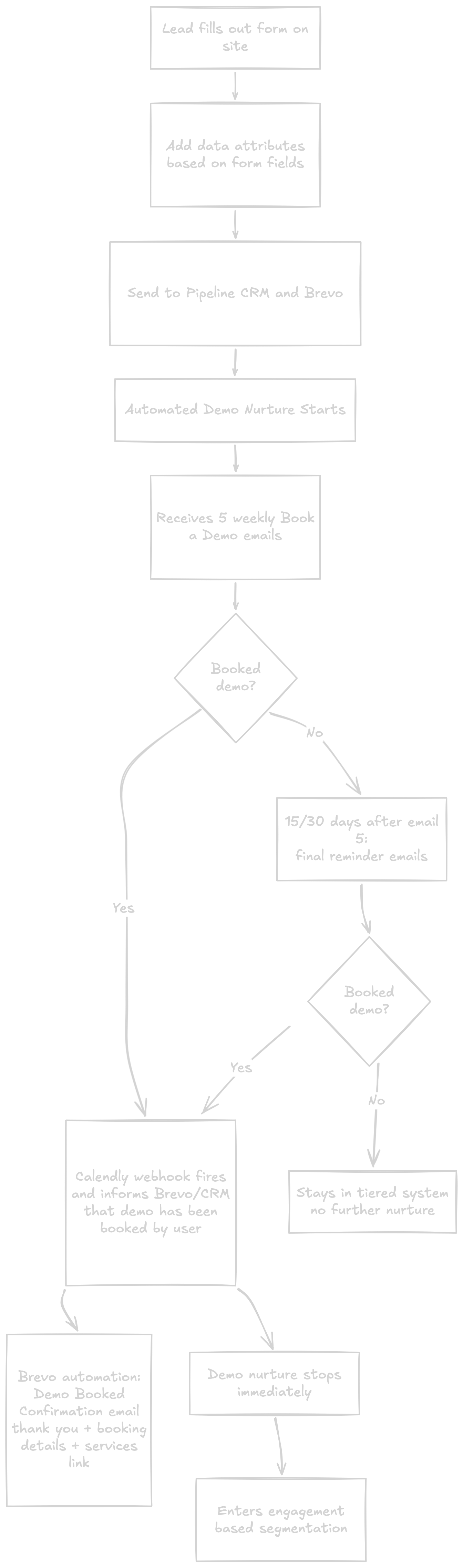
When someone submits a form on our site, the data goes to the backend, gets tagged with the form source, primary audience, and original/latest touch source, then gets pushed in parallel to both the CRM and the marketing platform. The marketing platform also pulls IS_CLIENT status from the CRM so we know whether this person is already a customer.
If they came in through the contact form (i.e., they're explicitly interested in talking to sales), they enter an automated demo nurture sequence: five weekly emails reminding them to book a demo, with two more reminder emails at 15 and 30 days after the fifth one if they still haven't booked. The sequence stops the moment they book.
The booking itself runs through Calendly. When someone books, a webhook fires that updates both the marketing platform (DEMO_BOOKED flag, date, event name) and the CRM (status set to "Demo Scheduled," summary line appended with booking details, attribution preserved if the contact already existed). The marketing platform sends a confirmation email automation, the demo nurture stops immediately, and the contact moves into engagement-based segmentation.
The piece I'm proudest of in this flow is the attribution logic. If a contact already exists in the CRM with an original lead source and assigned rep, the demo booking does not overwrite any of that. Instead it appends to the contact's history. This sounds obvious in retrospect but it's a common bug in CRM integrations. A lot of implementations just upsert blindly and overwrite real attribution data, which makes downstream reporting useless.
The B2C Purchase Flow
The B2C side is simpler in shape but has more interesting state management. When someone buys a training through our checkout, a Stripe webhook fires and kicks off a three-email sequence designed to keep them engaged after their initial purchase.
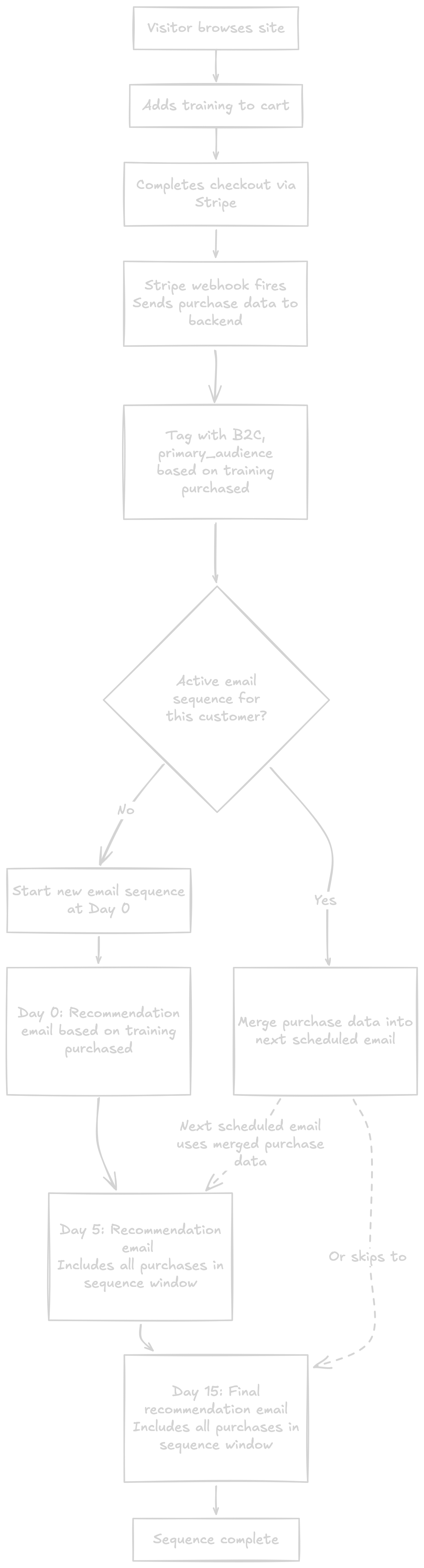
The flow tags the customer with B2C and a primary audience based on what they bought (different training programs map to different audiences), then checks whether there's already an active email sequence for that customer. If there isn't, a new sequence starts at Day 0 with a recommendation email. If there is, the new purchase data gets merged into the existing sequence and no new Day 0 email goes out.
That merge logic is the thing I want to call out, because it's the kind of edge case that's easy to miss and bad if you do.
If someone buys on Day 0, then buys again on Day 3, you don't want them to get a fresh Day 0 email three days after their first one. That's spam. What you want is for the Day 5 email (which is already scheduled) to include both purchases when it goes out. The same logic applies if they buy after Day 5 but before Day 15: the Day 15 email picks up the merged purchase data.
The sequence ends after Day 15. Customers who keep buying continue to merge into whatever sequence they're in, but they don't get retriggered into a new one. The whole thing is designed to feel like a single ongoing conversation rather than a bunch of overlapping campaigns.
The Webinar Registration System
We run webinars as a top-of-funnel content play. People register, attend, and ideally end up in the lead nurture or sales pipeline downstream. The registration system is more complex than it looks because it has to handle a lot of different organization types, multi-webinar registrants, and attribution that flows through to demo bookings months later.
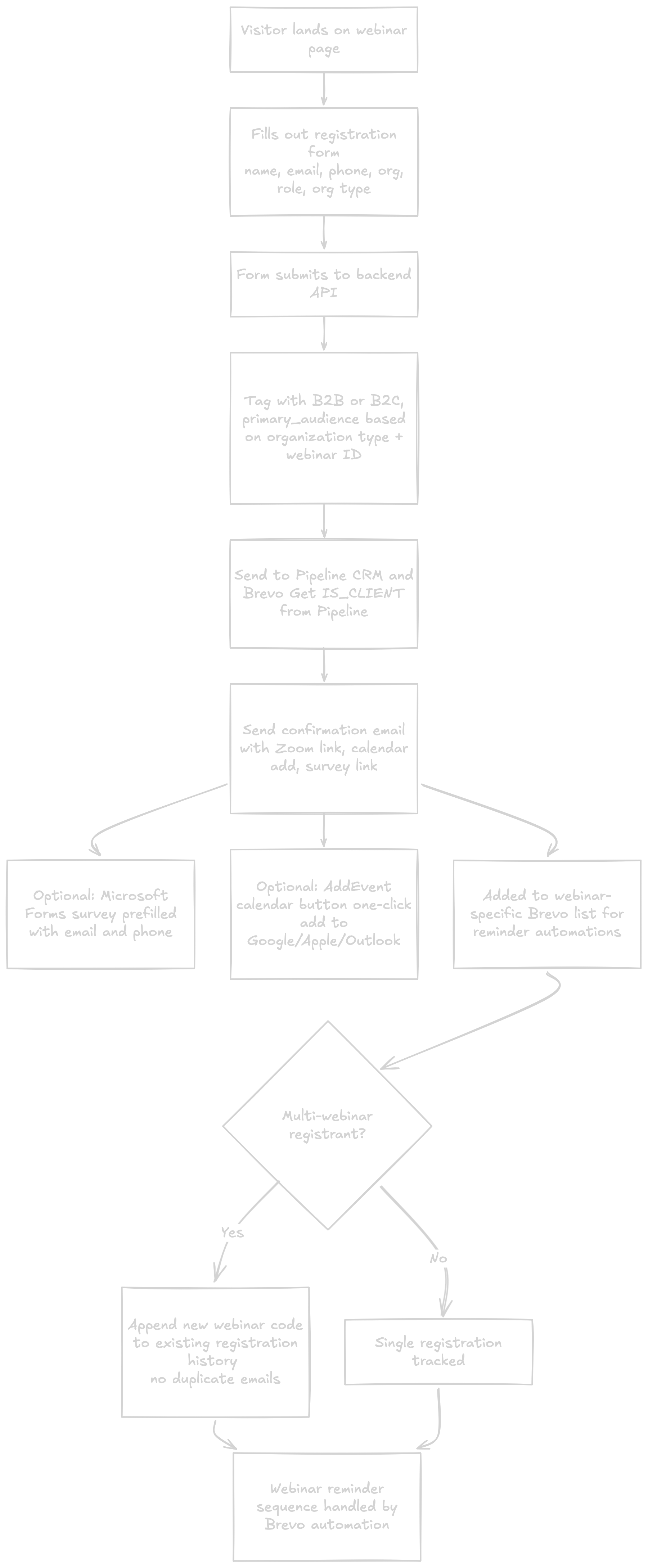
Each webinar has a unique code (WB001 through WB006) that gets tracked across both the CRM and the marketing platform. When someone registers, the form data goes to the backend and gets tagged with B2B or B2C based on their organization type, primary audience based on the same, and the specific webinar code. Then it syncs to both systems in parallel.
The marketing platform sends a confirmation email immediately with the Zoom link, an AddEvent calendar button for one-click calendar adds, and an optional Microsoft Forms survey link prefilled with their email and phone. They get added to a webinar-specific list that triggers reminder emails before the event.
Two pieces of this flow are worth highlighting. First, the audience mapping: organization type on the form (e.g., "Provider Organization," "Assisted Living," "YMCA") maps to a primary audience attribute that drives downstream segmentation across all systems. So a webinar registrant from a YMCA gets tagged YMCA everywhere and receives content tailored to that audience long after the webinar itself.
Second, the multi-webinar registration handling. If someone registers for WB003 in February and WB005 in April, their webinar history gets concatenated rather than overwritten. Both the CRM and the marketing platform store something like "WB003, WB005" so the full registration history is visible. The deduplication logic prevents duplicate codes if someone accidentally registers twice. Long-term, this lets us see who's the most engaged across multiple webinars and target them differently.
How I Actually Built This
I'm not a traditional engineer. I came into this work as a web developer, but I've increasingly become an architect and operator: I design the systems, make the decisions about what should happen and how, and use AI tooling extensively for implementation.
In practice, that looks like this. I figure out the architecture: what flows need to exist, what data has to move where, what the edge cases are, what the integrations should look like. I write specs and Figma diagrams that capture the logic. Then I work with AI tools to implement specific pieces: webhook handlers, API request scaffolding, template variations, debugging when things break. The design decisions and the integration patterns are mine. The boilerplate code is largely AI-accelerated under my direction.
I think this is going to be a much more common way to work in marketing engineering and adjacent roles over the next few years. The bottleneck on building this kind of infrastructure isn't typing speed. It's having the judgment to know what to build, in what order, with what edge cases handled. AI tools are great at the implementation. They can't tell you what the right architecture is for your specific business.
For this project, that meant I could ship something at a pace that would normally require a small engineering team. A one-person marketing tech function at a small company is only possible because of this kind of leverage.
What's Still Rough
A few things I'd build into v2 if I had the time:
The renewal flow has a gap around customers who don't renew. That's currently handled manually, which means it sometimes doesn't happen as cleanly as it should. A proper churn flow would trigger automatically and route those contacts into a different program rather than waiting for someone to notice.
Canceled and rescheduled demos aren't handled gracefully. If someone reschedules, the original demo nurture should re-pause cleanly, and the new booking should fire a fresh confirmation. Right now this is brittle.
The tier transition logic for engagement-based segmentation lives in the marketing platform's segmentation rules, but it isn't fully wired through end-to-end yet. Someone in the most-engaged segment who goes quiet for 90 days should automatically drop into a re-engagement segment. The rules exist; the dynamic transitions need more work.
Attribution is a known weak point. The systems we use don't all support UTM tracking end-to-end, which means tying specific revenue back to specific campaigns is harder than it should be. This is partly a tooling problem and partly a process problem, and it's the area where I think the program would benefit most from additional investment.
The Takeaway
Most small marketing teams operate without proper lifecycle infrastructure because building it requires both marketing thinking and technical execution, and most companies don't have anyone who can do both. If you can be that person, you can build systems that meaningfully shift business outcomes (more demos booked, better attribution, healthier email engagement, customers staying longer) at a fraction of the cost of buying enterprise tooling.
The architecture above is what I built for a small B2B company. The same patterns scale up to bigger companies with more sophisticated tools (Braze, Iterable, Customer.io). What stays the same is the underlying logic: capture the lead well, preserve attribution, separate marketing email from transactional email, use behavioral signals to drive segmentation, and treat customers differently from leads.
If you're thinking through this kind of work and want to talk shop, I'm at scottpetersonSE@gmail.com.
Interested in working together?
Drop me a message about the role, the stack, or what you're trying to build.